Building A Sustainable Fitness Routine Without Extremes
If you’ve ever started a new routine on a Monday and felt burned out by Thursday, I've got to tell you, you’re incredibly human. Most fitness plans fail because they’re built for an imaginary life: unlimited time, perfect energy, zero stress, and a fridge full of prepped meals. A girl can dream.
A sustainable fitness routine is different.
It’s flexible. It’s realistic. And it’s exactly what busy, high-achieving women need when they want to feel confident in their bodies again—without extremes, guilt, or the constant start-over cycle.
I coach CEOs. High-level analysts. PR Execs. This is the approach I use to help these women build a balanced system that combines smart training + supportive nutrition + real-life planning.
What “sustainable fitness” actually means (and what it doesn’t)
Sustainable fitness means you can keep going even when life gets lifey.
It does not mean:
Working out 7 days/week
Cutting out carbs/sugar/alcohol forever
“Earning” food with exercise
Starting over every time you miss a day
It does mean:
A plan that fits - and flexes with - your real schedule
A routine you can repeat at 70–80% effort on hard weeks
Habits that support your energy, mood, and confidence
Progress that compounds over months (not days)
Step 1: Pick your minimum effective dose (MED)
If your plan only works on your best week, it’s not a plan—it’s a fantasy.
One of the fastest ways to stop the all-or-nothing cycle is to define what counts as a win.
Your MED aka minimum effective dose is the smallest amount of input, the simplest routine that still moves you forward.
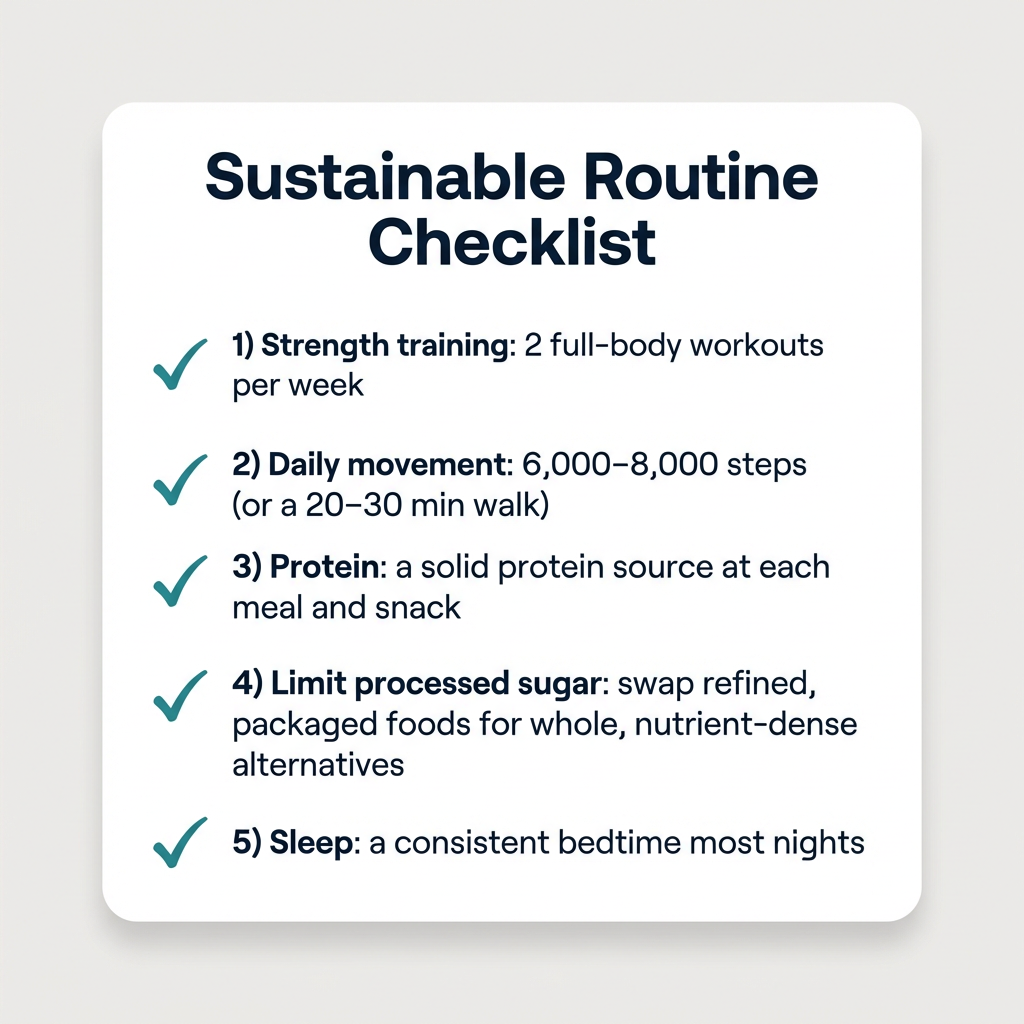
A strong starting point for most busy women:
Strength training: 2 full body workouts per week
Daily movement: 6,000–8,000 steps (or a 20–30 min walk)
Protein: a solid protein source at each meal and snack
Limit processed sugar: swapp refined, packaged foods for whole, nutrient-dense alternatives
Sleep: a consistent bedtime most nights
Then, when you have more capacity, you scale up. But your baseline stays doable regardless of how off-track the day or week goes.
Step 2: Build your routine around your life (not motivation)
Motivation is a spark. Lovely when it ignites - and don't hesitate to lean into that energy. But motivation is not reliable.
Systems are reliable. Systems work regardless of emotion.
Start with your calendar:
Identify your most predictable open windows. Don't force it. If you're not a morning person, don't pick 5am.
Choose 2–4 workout slots that are realistic. Block this time in your calendar.
Add a backup option for each slot. I like to create 15, 20 and 30 minute "plan B" workouts for my clients for the days when they truly run out of time and need to workout from home or have limited hours.
Example:
Tuesday 5pm: strength workout
Thursday 12pm: strength workout
Backup: 20-minute dumbbell circuit at home if meetings run long
This is how you stay consistent without needing to “feel like it.”
Fitness fitting your life > trying to make your life fit fitness. Learn how.
Step 3: Stop chasing the perfect workout—use a repeatable structure
A sustainable routine is built on repeatable workouts, not random ones.
If you’re constantly switching programs, you’ll feel like you're working… but you won’t build momentum. This isn't a great strategy for results.
Instead, use a simple full-body structure you can repeat for 6–12 weeks. Great for seeing progress. Great for minimizing decision fatigue. Great for consistency.
Squat/lunge pattern
Hinge pattern (deadlift/hip bridge)
Push (press/push-up)
Pull (row/pull-down)
Core + carries
Progress comes from doing the basics well, then gradually increasing the challenge overtime.
Step 4: Nutrition should support your training (not hijack your life)
Most women I work with don’t need a more complicated diet plan. They need a calmer, clearer strategy that:
fuels training
supports recovery
helps body composition change over time
doesn’t turn food into a full-time job
Start with 3 daily diet anchors:
If you do nothing else, these three habits create a huge ripple effect:
Protein at breakfast. Aim for 25-30 grams to increase satiety, support muscle recovery and reduce cravings all in all making the rest of the day a bit easier.
A planned afternoon snack. Have a 250-300 calories snack with protein and fiber mid-afternoon so that you don't arrive at dinner time starving.
A balanced dinner. Protein + produce + a satisfying carb and healthy fats.
Use the “good / better / best” method:
This is how you can stay consistent without perfection.
Good: grab-and-go protein + fruit. This is your out-of-time, when-all-else-fails option.
Better: balanced meal with protein + carbs + fats.
Best: a meal that’s balanced and supports your training goal that day.
No shame. Not boring. Just options.
Don’t fear carbs (especially if you lift):
Carbs aren’t your enemy—they’re fuel. In fact, carbs are the primary fuel source. When you strength train, carbs can support:
better workouts
better recovery
better mood and sleep
Sustainable nutrition is about repeatable systems, not perfection and extremes.
Step 5: Plan for the “messy middle” (this is where results are made)
Planning for the off days isn't giving up ahead of time. It's being honest with yourself. The "messy middle" is where routines - and therefore results - are made or broken: travel, stress, sick kids, deadlines, holidays, crappy sleep.
Instead of waiting for life to calm down, create a messy-middle plan:
20-minute bodyweight workouts you can do anywhere
a “hotel gym” template for travel days
a short grocery list that anyone can follow for busy weeks
a 3-meal recipe rotation you actually look forward to eating
Sometimes "that'll do" is just what you need.
Step 6: Track progress like a coach (not like a critic)
Scale weight can be one data point, but it’s not the whole story.
Track these too:
strength numbers (reps/weight)
energy and mood
sleep quality
hunger and cravings
consistency streaks
how your clothes fit
confidence (yes, really)
If you’re getting stronger and more consistent, your body is changing—even if the scale is being dramatic.
P.S. From experience (both as a coach and a woman on her own fitness journey), I know that stepping on the scale can be an emotional experience. If that's the case for you, you can solely rely on the above metrics, and ignore scale weight completely.
Step 7: Make it personal (because your body isn’t a template)
The internet loves one-size-fits-all plans. Real results come from personalization.
Your routine should reflect:
your current schedule and stress load
your training history
your relationship with food
your recovery capacity
your goals (fat loss, strength, energy, confidence)
If you’ve tried “everything” and nothing sticks, it’s usually not a willpower problem—it’s a strategy problem. That's why working with an expert can be the real game changer.
A simple sustainable fitness routine you can start this week
Use this as a starting template (and adjust it to your life):
2 strength sessions (40–60 min): full-body
2–3 low-intensity walks (20–30 min): phone-free if possible
Protein at every meal: aim for a palm-sized portion
Reduce processed ingredients: swap real food options for 1-2 highly processed foods
One planned treat: because real life includes birthdays and date nights
One recovery habit: bedtime routine, stretching, or a 10-minute winddown
Do this for 4 weeks. Then reassess.
The mindset shift that changes everything
I spent a lot of years believing that if I didn't follow the perfect diet perfectly, if I didn't stick to my routine with no missed days, then I'd never get the results I wanted.
Ironically, when I eased up on myself, uncomplicated my diet and followed a workout routine that fit my life (rather than trying to make my life fit a fitness pros fitness routine), I actually started getting those exact results.
The shift is simple:
Accept that fitness is a lifelong pursuit with no end date, no finish line, no rush. As soon as you accept that, the pressure is off. You realize that life is the point and fitness is a tool for happiness and longevity.
With that mindset, you get to follow a routine that:
respects all aspects of your life
builds confidence with small, daily wins
doesn’t punish you for being human
Sustainable fitness is not about extremes. It’s about becoming the kind of person who keeps showing up because she has a plan for real life.
Want a plan that’s built for your body and your schedule?
If you’re a busy, high-achieving woman who’s tired of the start-stop cycle, a free strategy session is the easiest step to breaking that cycle.
In this call, we’ll:
Get clear on what you want (fat loss, body recomposition, strength, energy, confidence)
Identify what’s been keeping you stuck (without judgment)
Map out the simplest training + nutrition plan that fits your real schedule
Decide whether premium 1:1 coaching is the right fit for you
Book your free strategy session and let’s build a routine you can actually sustain.